Initiatives on Behalf of the Environment
- Environmental Policy
- TCFD
- TNFD
- Conservation of water resources
- Reduction of waste and management of hazardous substances
- Promoting renewable energy
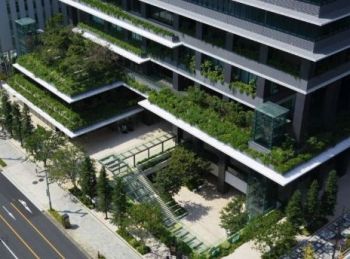
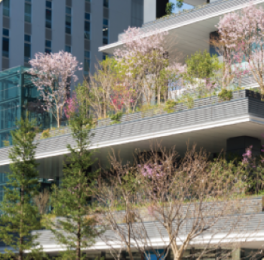
- Promotion of wall greening and rooftop greening
- Cooperation with tenants and property managers
- Consideration for the environment and urban revitalization in real estate investing
- Sustainability certification
Recognition of natural capital
JPR and TRIM, which is responsible for asset management, believe that incorporate ESG considerations into real estate investment and management operations is essential to realizing a sustainable society, and at the same time contributes to the steady execution
of JPR’s basic policy of resolving social issues and maximizing unitholder value. Based on this approach, TRIM has established a sustainability policy and is working to put it into practice through its real estate investment management and business.
People’s daily lives and economic activities are supported by the benefits of nature (natural capital) derived from ecosystems that are underpinned by biodiversity. However, nature and biodiversityloss has the potential to increase physical and transition risks
throughout the value chain.
On the other hand, JPR recognizes that promoting climate change countermeasures, the efficient use of resources and reduction of excess consumption, sustainable production and consumption, and investment in biodiversity conservation and restoration
through property management and collaboration with tenants and suppliers, not only contributes to resolving envirionmental challenges, but also create opportunities for JPR's sustainable growth.
Through these initiatives, JPR and TRIM will contribute to a nature-positive future and work to strengthen the resilience and competitiveness of their portfolio.
Disclosure based on TNFD recommendations
This disclosure refers to the recommendations published in September 2023 by the Taskforce on Nature-related Financial Disclosures (TNFD) and discloses JPR’s and TRIM’s dependencies and impacts on natural capital, risks and opportunities, and metrics and targets.
It is organized in line with TNFD's LEAP approach for identifying and assessing nature-related issues. In accordance with the TNFD recommendations, it is structured around “general requirements”and the “TNFD recommended disclosures”(governance, strategy, risk and impact management, and metrics and targets).
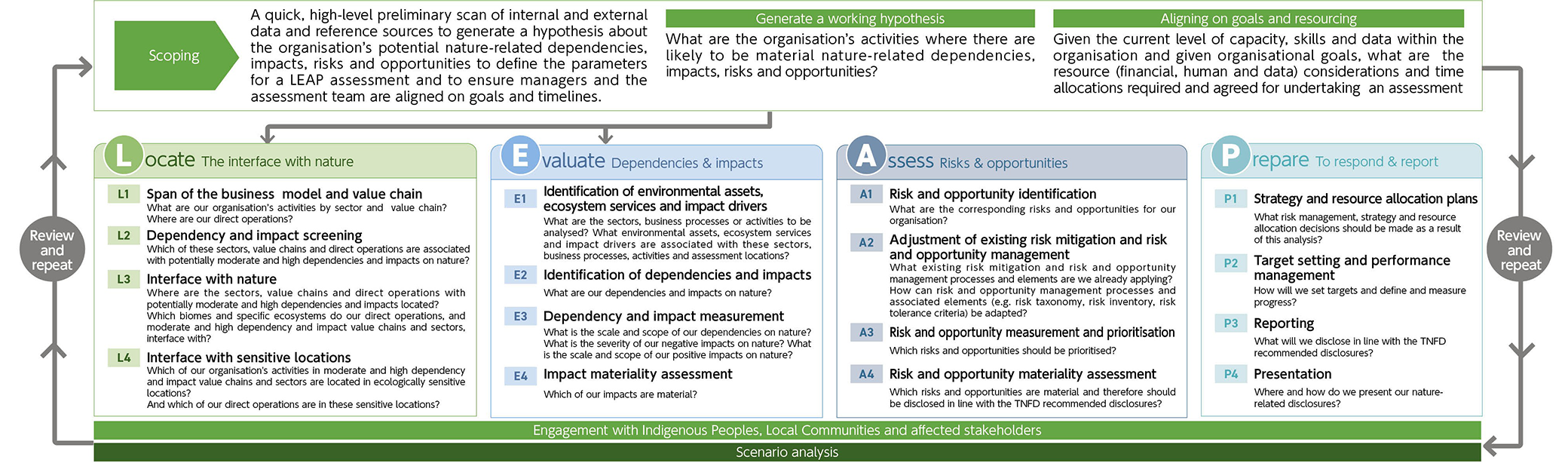 *Figure: Conceptual diagram of the LEAP approach (excerpted from the TNFD recommendations)
General requirements
Application of materiality
JPR identifies its sustainability initiatives and materiality (key issues) from two aspects: social needs from stakeholders and its business sector. JPR applies the same approach in this disclosure, considering nature-related social needs and the financial impact on JPR’s business (financial materiality), to explain what it considers material it considers material.
Scope of disclosure
This disclosure covers JPR's investment assets, real estate such as offices and retail facilities, and presents nature-related dependencies and impacts with respect to “real estate investment management” as its direct operations and “real estate development” as an upstream part of the value chain. In addition, for direct operations, JPR has analyzed and disclosed dependencies, impacts, risks and opportunities in detail for all 67 properties it manages (properties held during 2025).
Location of nature-related issues
JPR recognizes that nature-related issues vary by region.
It confirmed that ecosystem conditions and nature-related dependencies and impacts differ for some properties.
As this disclosure analyzed nature-related risks and opportunities across all properties, JPR will consider conducting more detailed region-by-region analysis in the future.
Integration with other sustainability-related disclosures
JPR recognizes that nature-related issues are connected to a range of other sustainability-related issues, such as climate change and human rights. For this reason, this disclosure provides nature-related information based on the TNFD recommendations, and JPR will consider integrating other sustainability-related disclosures in the future, including climate-related disclosure.
Time horizons considered
This disclosure considers dependencies, impacts, risks and opportunities over short-term and medium-to long-term time horizons.
JPR will further examine what time horizons should be set as it advances scenario analysis and region-by-region analysis.
Engagement with indigenous peoples, local communities and affected stakeholders
TRIM strongly recognizes the importance of respecting the human rights of all stakeholders involved in its business, and has established the “Tokyo Tatemono Realty Investment Management Human Rights Policy,” which it puts into practice as the basis for all of its business activities. Based on the Human Rights Policy, TRIM strives to understand adverse impacts of its business activities on human rights from the perspective of those impacted by them and engage in dialogue with relevant stakeholders to address and improve these impacts.
For details, please see the section “Human rights policy and engagement activities.”
Governance
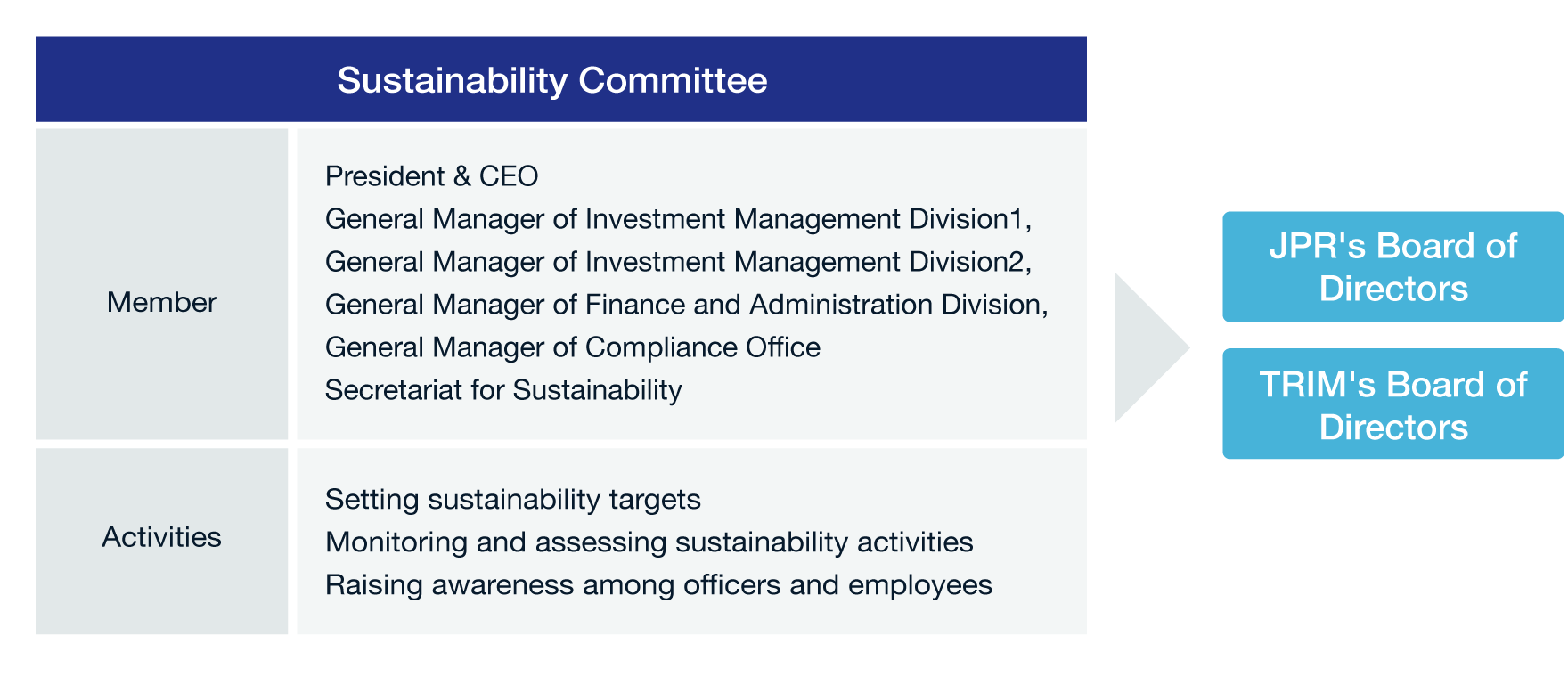
TRIM has positioned its “sustainability policy” at the core of its management and has built a sustainability promotion structure aimed at maximizing unitholder value while working in step with the environment and society. The Sustainability Committee, chaired by the President & CEO, meets in principle four or more times a year to deliberate on key sustainability issues, KPIs and initiatives and to monitor their implementation status, while also sharing and discussing the results of risk and opportunity analysis relating to environmental issues such as climate change, natural capital and biodiversity.
Important matters relating to climate- and nature-related issues decided or deliberated by the Sustainability Committee, together with monitoring results, are regularly reported to JPR’s Board of Directors (consisting of the Executive Officer and Supervising Officers) and to TRIM’s Board of Directors, which oversee sustainability management, including environmental issues, and the response to climate- and nature-related risks and opportunities based on the TCFD and TNFD recommendations.
In addition, based on the results of their approval and oversight, TRIM’s dedicated sustainability department takes the lead in working with related divisions to review climate- and nature-related strategy, risk and opportunity assessment, and disclosure, before submitting these matters to the Sustainability Committee for approval and oversight again, thereby putting a continuous improvement cycle into practice.
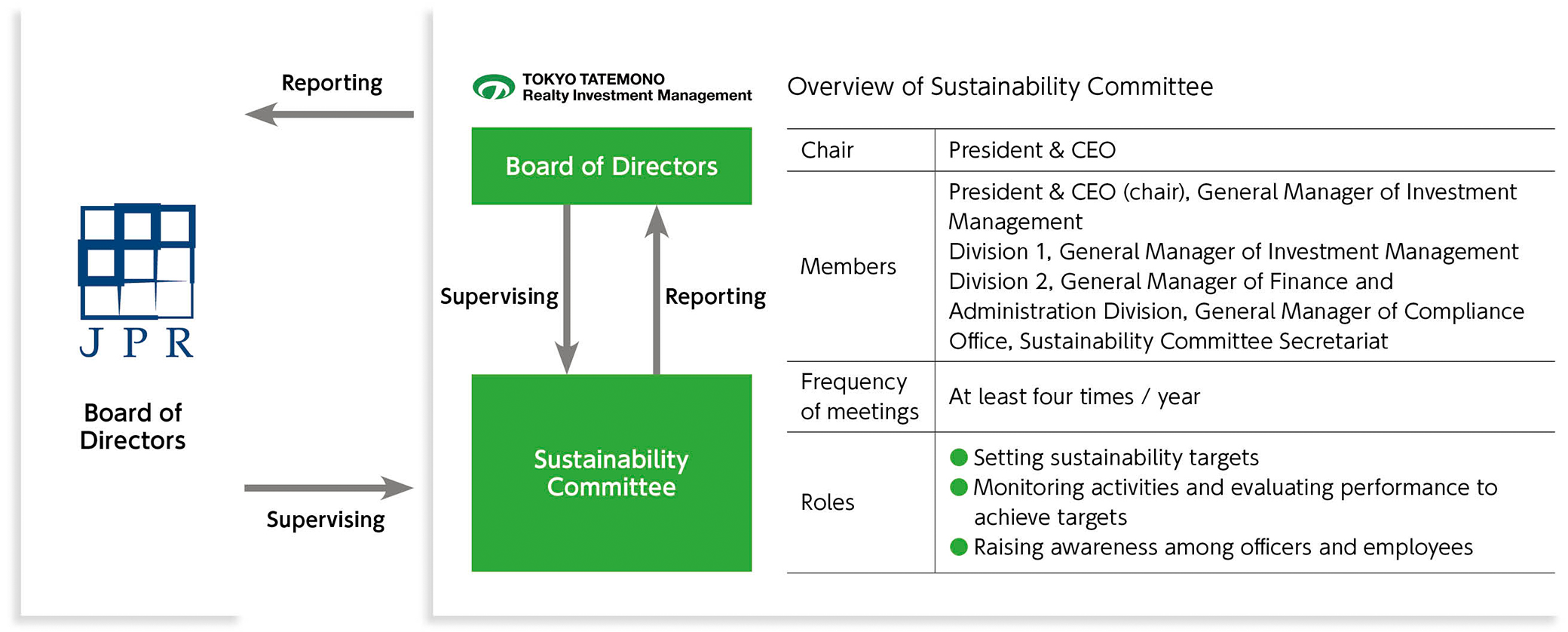 *The Sustainability Committee has invited outside experts with knowledge of sustainability as special committee members.
Human rights policy and engagement activities
Respect for human rights
As a member of the Tokyo Tatemono Group, TRIM supports the Universal Declaration of Human Rights in the International Bill of Human Rights, international labor standards such as the ILO Declaration on Fundamental Principles and Rights at Work, and the UN Guiding Principles on Business and Human Rights. TRIM has been committed to respect human rights in its corporate activities in line with the “Tokyo Tatemono Group Compliance Manual,” and conducts human rights due diligence and works to identify, mitigate, correct and remedy human rights issues arising from its business based on the "Tokyo Tatemono Realty Investment Management Human Rights Policy." TRIM has also established "Sustainable Procurement Standards" and requires suppliers to respect human rights.
Stakeholder Engagement
Based on its corporate philosophy of “delivering value to all stakeholders, including customers, employees, society, and unitholders, by providing professional investment management services based on integrity and a sense of responsibility,” TRIM strives to enhance its investment management capabilities in order to meet the social demands placed on JPR and TRIM.
TRIM emphasizes stakeholder engagement by which TRIM uses dialogues with stakeholders for its asset management and business management through a variety of day-to-day mechanisms.
Strategy
Dependencies and impacts in the value chain
Below is an overview of dependencies and impacts on nature and their materiality with respect to real estate investment management as its direct operations and real estate development as an upstream value chain. Specifically, using the “ENCORE” tool developed by the United Nations Environment Programme (UNEP) and a British non-profit Global Canopy, JPR classified the materiality of dependencies and impacts into five levels, from Very High to Very Low.
For real estate investment management (direct operations), JPR confirmed strong exposure to dependencies on “visual amenity services” (e.g. views of greenery from windows that increase job satisfaction and reduce stress).
For real estate development (upstream), JPR confirmed a strong relationship with dependency on “rainfall pattern regulation” and impacts such as “disturbances (e.g., noise, light).”
Dependencies on nature
| Business activity | Value chain |
Provisioning services | Regulating services | ||||||
|---|---|---|---|---|---|---|---|---|---|
| Water supply | Other provisioning services - Animal-based energy |
Soil and sediment retention | Flood mitigation | Water flow regulation | Rainfall pattern regulation | Local climate regulation |
Global climate regulation |
||
| Real estate investment management | Direct operations | VL | M | VL | VL | L | VL | ||
| Real estate development | Upstream | M | VL | H | M | M | VH | L | M |
| Business activity | Value chain |
Regulating services | Cultural services |
||||||
|---|---|---|---|---|---|---|---|---|---|
| Solid waste remediation | Storm mitigation | Water purification | Air filtration | Noise attenuation | Other regulating and maintenance services - Dilution by atmosphere and ecosystems |
Other regulating and maintenance services - Mediation of sensory impacts (other than noise) |
Visual amenity services |
||
| Real estate investment management | Direct operations | L | VL | VL | VL | VH | |||
| Real estate development | Upstream | VL | M | M | VL | VL | L | VL | |
Impacts on nature
| Business activity |
Value chain |
Land / freshwater / ocean-use change | Climate change | Pollution | Resource use | Invasive alien species |
|||||
|---|---|---|---|---|---|---|---|---|---|---|---|
| Area of land use | Area of freshwater use | Area of seabed use | GHG emissions | Emissions of non- GHG air pollutants |
Emissions of soil and water pollutants |
Generation and release of solid waste | Disturbances such as noise and light | Water use | Introduction of invasive alien species |
||
| Real estate investment management |
Direct operations |
L | VL | VL | L | VL | L | L | |||
| Real estate development |
Upstream | L | M | M | H | L | H | M | VH | L | L |
Disclosure Based on TNFD Recommendations
In the preceding section, it was confirmed that JPR’s owned properties may have dependencies and impacts on nature at the real estate development and investment management stages. For this reason, JPR analyzed ecosystem conditions and dependencies and impacts on nature for all properties it owns in order to identify locations that should be prioritized for addressing nature-related issues (priority locations).
JPR used the indicators shown in the table below to assess ecosystem conditions, and environmental performance data for each property (2025 electricity consumption, water consumption, waste generation, and GHG emissions (Scope 1 + 2 (location-based) + 3)) to analyze dependencies and impacts.
Indicators used to analyze ecosystem conditions
| Item | Indicator |
|---|---|
| Biodiversity importance |
|
| Ecosystem integrity |
|
| Physical water risk |
|
- Assessed based on the area within a 1 km radius of each property’s location occupied by “nature conservation areas” and “natural parks” designated under the Natural Parks Act. Data source: the National Land Numerical Information Download Service of the Ministry of Land, Infrastructure, Transport and Tourism and Natural Environmental Survey Web-GIS of the Ministry of the Environment.
- Assessed based on the area within a 1 km radius of each property’s location occupied by Key Biodiversity Areas, which are important areas for biodiversity conservation selected according to international standards. Data source: the National Land Numerical Information Download Service of the Ministry of Land, Infrastructure, Transport and Tourism.
- An index indicating how much of the original biodiversity is still left. It is intended to assess the negative impact of human activities, such as land use, relative to the natural state. Data source: the Natural History Museum (UK).
- An index indicating the ratio of water withdrawals to water supply within a watershed. It is intended to indicate the degree of tightness in water supply and demand. Data source: the Aqueduct Water Risk Atlas of the World Resources Institute (WRI).
Analysis results
The analysis confirmed that biodiversity importance (proximity to KBAs) and nature-related dependencies and impacts are significant for some of the properties shown in the table below.
Among these, Sencity Bldg. and Yakuin Business Garden showed a high degree of relevance in both ecosystem conditions and dependencies and impacts, and were identified as priority locations for JPR. As detailed nature-related information for these properties has not yet been obtained, and because there are not much differences in business content by region, JPR examined all properties it owns for the purposes of this risk and opportunity analysis.
| Property name | Location | Ecosystem conditions in the property area |
Dependency | Impact | Overall assessment |
||||
|---|---|---|---|---|---|---|---|---|---|
| Ecosystem importance | Ecosystem integrity | Water stress | Electricity consumption | Water consumption | Waste generation | GHG emissions | |||
| Sencity Bldg. | Chiba | ★ | ★★★ | ★★ | ★★★ | ★★★ | ★★★ | ★★★ | 18 |
| Yakuin Business Garden | Fukuoka | ★★★ | ★★ | ★ | ★★★ | ★★★ | ★★★ | ★★★ | 18 |
| Yume-ooka Office Tower | Kanagawa | ★ | ★★ | ★★ | ★★★ | ★★★ | ★★★ | ★★★ | 17 |
| Nakano Central Park East | Tokyo | ★ | ★★ | ★★ | ★★★ | ★★★ | ★★★ | ★★★ | 17 |
| Tanashi ASTA | Tokyo | ★ | ★★ | ★★ | ★★★ | ★★★ | ★★★ | ★★★ | 17 |
| JPR Musashikosugi Bldg. | Kanagawa | ★ | ★★ | ★★ | ★★★ | ★★★ | ★★★ | ★★★ | 17 |
| Kawasaki Dice Bldg. | Kanagawa | ★ | ★★ | ★★ | ★★★ | ★★★ | ★★★ | ★★★ | 17 |
| FUNDES Ueno | Tokyo | ★ | ★★ | ★★ | ★★★ | ★★★ | ★★★ | ★★★ | 17 |
(KBA area)]
(BII value)]
(20-40%)” ★“Low - Medium
(10-20%)” or below
Assessment of risks and opportunities
Assessment of nature-related risks and opportunities
Based on the identified dependencies and impacts, JPR examined the risks and opportunities that may arise for the investment corporation. Following of a qualitative assessment of their materiality to JPR, the risks and opportunities considered material are as shown below.
| Category | Item | Content of risks and opportunities | |
|---|---|---|---|
| Transition risks |
Policy | Regulatory enhancement on biodiversity |
|
| Regulatory enhancement on water resources |
|
||
| Regulatory enhancement on water resources |
|
||
| Market | Increase in demand for properties that are advanced in addressing nature-related issues |
|
|
| Introduction of environmental performance and other criteria into real estate appraisals |
|
||
| Reputation | Decline in brand value due to delayed response to nature-related issues |
|
|
| Liability | Planting of invasive alien species and the spread and establishment of pests |
|
|
| Physical risks |
Acute | Increase in natural disasters due to climate change and other factors associated with ecosystem degradation |
|
| Chronic | Disruption of the water cycle due to climate change and water withdrawal by other companies |
|
|
| Rising average temperatures and the acceleration of the heat island effect |
|
||
| Opportunities | Resource efficiency | Improved water use efficiency |
|
| Reduction in waste generation |
|
||
| Products and services | Increase in demand for properties with green spaces and waterfronts |
|
|
| Market | Development of new investor segments |
|
|
| Capital flows and financing | Satisfaction of financing conditions |
|
|
| Ecosystem protection, restoration and regeneration | Maintenance and management of green spaces surrounding business sites |
|
|
Risk and impact management
Process for identifying and assessing dependencies, impacts, risks and opportunities
As shown in the preceding “Strategy” section, JPR qualitatively organized an overview of materiality for its direct operations and upstream activities, with respect to dependencies and impacts on nature, to gain an overall picture. Furthermore, JPR conducted a comprehensive assessment of each property using the surrounding ecosystem conditions and environmental performance datasets, examined priority locations, and identified nature-related dependencies, impacts, risks and opportunities.
JPR looks forward to conducting scenario analysis, quantitative analysis of risks and opportunities, and materiality assessment in the future.
Process for managing dependencies, impacts, risks and opportunities
TRIM’s Sustainability Committee, chaired by the President & CEO, meets four or more times a year in principle to deliberate on key sustainability issues, KPIs and initiatives, and to monitor their implementation status. Dependencies, impacts, risks and opportunities relating to environmental issues such as natural capital and biodiversity are also managed by the Sustainability Committee.
Integration of nature-related risks into company-wide risk management
Nature-related risks are integrated with risks related to operations and management. They are monitored and managed through multiple verification systems. TRIM has established the Risk Management Committee to improve the effectiveness of its risk management, in accordance with its Risk Management Regulations. The Committee deliberates on topics including risk identification, response to assessment, monitoring, and improvement measures. Contents, progress and results of the Committee's deliberations are reported to TRIM's Board of Directors.
Metrics and targets
JPR has set targets the following indicators and targets relating to nature-related dependencies, impacts, risks and opportunities.
Going forward, JPR will continue to consider the appropriate indicators and targets, referring to the disclosure metrics presented in the TNFD recommendations.
| Item | Indicator | Target |
|---|---|---|
| Water resources |
Water use per floor area | 10% reduction by 2030 (compared to the 2017 level) |
| Waste | Recycling rate | Reduce by up to 70% by 2030 (in principle, for the properties over which JPR has management authority) |
| GHG | Total GHG emissions | 46.2% reduction by 2030 (compared to the 2019 level); net zero by 2050 |
Initiatives for nature-related issues
Case studies of biodiversity initiatives
JPR gives consideration to biodiversity conservation and restoration to the extent possible, to biodiversity conservation and restoration, and contributes to realizing a society that coexists with nature.
Otemachi Tower
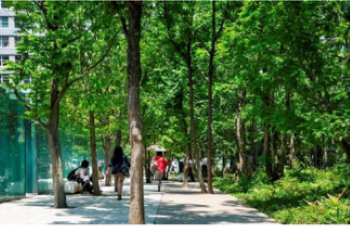
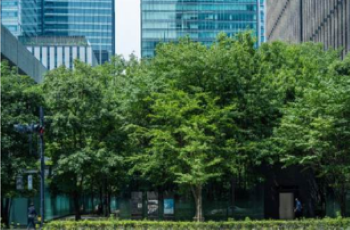
The Otemachi Tower (Chiyoda Ward), a mixed-use office building for which JPR holds the land ownership (land with leasehold interest) and was developed by sponsor Tokyo Tatemono Co., Ltd., is home to Otemachi Forest, a green space that covers approximately one-third of the entire site, about 3,600 m² that recreates a real forest in an office district lined with high-rise buildings. It has obtained various biodiversity-related certifications, being one of the first sites to receive the highest rating of “★★★ (Triple Star)” through the Certification System for Securing Quantity and Quality Urban Green Space (TSUNAG). Monitoring surveys recorded approximately 200 species of trees and ground cover as of 2021, and the presence of rare species and the establishment of multiple bird species have also been confirmed.
Tokyo Square Garden
At JPR's Tokyo Square Garden (Chuo Ward), the roughly 3,000 m² green space Kyobashi Hill stretches from the first basement floor to the fifth floor above ground. In its area where there are few cohesive green spaces, the building has obtained the ABINC Certification from the Association for Business Innovation in harmony with Nature and Community (ABINC) and “Oasis in the City” certification of Social and Environmental Green Evaluation System (SEGES), demonstrating as a building that gives consideration to biodiversity. In addition, JPR uses Kyobashi Hill to promote initiatives for coexistence with nature and resource recycling in the city. Building on this biodiversity conscious green space, the facility installed "Kyobashi Nest Boxes" in April 2026, made from recycled pruned branches, fallen leaves and building-derived waste materials. JPR has also introduced a system for reusing offcuts generated at events as nesting material for wild birds, as well as a system that allows nesting activity to be observed via live camera. These initiatives incorporate waste generated in the urban environment into the natural cycle while promoting understanding of biodiversity among tenants and visitors, and are positioned as an example of addressing nature-related issues and creating opportunities in urban real estate. JPR will continue to work on conserving biodiversity and countering the heat island effect, among other initiatives, through appropriate management of green spaces.