Initiatives on Behalf of the Environment
- Environmental Policy
- TCFD
- TNFD
- Conservation of water resources
- Reduction of waste and management of hazardous substances
- Promoting renewable energy
- Promotion of wall greening and rooftop greening
- Cooperation with tenants and property managers
- Consideration for the environment and urban revitalization in real estate investing
- Sustainability certification
Recognition of climate change
With the globalization of economic activities and the effects of population growth, various environmental issues such as climate change are growing more serious. At the Parties to the United Nations Framework Convention on Climate Change held in 2015 (COP21), the Paris Agreement was adopted, representing an agreement to keep the increase in average temperatures since the Industrial Revolution to well below 2ºC, and to aim for keeping the increase to 1.5℃. In addition, since 2021, the Japanese government has set a target of achieving net zero by 2050 and has been advancing GX (Green Transformation) initiatives, including the introduction of a new carbon pricing system. JPR recognizes that climate change will have a significant impact on its business, including tenant and supply chain activities, and has adopted a policy of contributing actively to the reduction of GHG emissions. We have identified “addressing climate change” as a material issue and set medium- to long-term targets with a scientific basis, as “46.2% reduction in total GHG emissions (compared to 2019) by 2030” and “net zero by 2050.”
Countering climate change
JPR works to reduce the impact of its business activities on climate change by reducing GHG emissions through the efficient use of energy in its office buildings, etc., and use of renewable energy. We also believe that the management of real estate with superior energy conservation will lead to the creation of business opportunities and improve competitiveness, and will therefore continue to engage in these initiatives.
Support for the TCFD recommendations
TRIM announced its support for the recommendations of the TCFD (Task Force on Climate-related Financial Disclosures), established by the Financial Stability Board (FSB), in May 2021, and also participated in the TCFD Consortium (which transitioned to a successor framework as of March 2026). TRIM conducted an analysis of climate change risks and opportunities based on the four core pillars (governance, strategy, risk management, and metrics and targets) of the TCFD recommendations, and is actively disclosing details of those initiatives.

Acquired Certification from Science Based Targets Initiative (SBTi)
JPR established greenhouse gas reduction targets by 2030 and 2050, and as those targets are deemed to be consistent with the level required by the Paris Agreement (aiming to hold the global average temperature increase to a level well below 2℃ above pre-industrial levels and purse efforts to limit the temperature increase to 1.5℃ above pre-industrial levels), and based on scientific grounds, JPR acquired certification from SBTi in April 2023.
SBTi is an international initiative jointly managed by CDP, United Nations Global Compact (UNGC), World Resources Institute (WRI) and World Wide Fund for Nature (WWF) that supports the setting of emission reduction targets based on scientific grounds and certifies them for companies to achieve the target of limiting the rise in global average temperature caused by climate change to 1.5℃.

Governance
TRIM has positioned its “sustainability policy” at the core of its management and has built a sustainability promotion structure aimed at maximizing unitholder value while working in step with the environment and society. The Sustainability Committee, chaired by the President & CEO, meets in principle four or more times a year to deliberate on key sustainability issues, KPIs and initiatives and to monitor their implementation status, while also sharing and discussing the results of risk and opportunity analysis relating to environmental issues such as climate change, natural capital and biodiversity. Important matters relating to climate- and nature-related issues decided or deliberated by the Sustainability Committee, together with monitoring results, are regularly reported to JPR’s Board of Directors (consisting of the Executive Officer and Supervising Officers) and to TRIM’s Board of Directors, which oversee sustainability management, including environmental issues, and the response to climate- and nature-related risks and opportunities based on the TCFD and TNFD recommendations. In addition, based on the results of their approval and oversight, TRIM’s dedicated sustainability department takes the lead in working with related divisions to review climate- and nature-related strategy, risk and opportunity assessment, and disclosure, before submitting these matters to the Sustainability Committee for approval and oversight again, thereby putting a continuous improvement cycle into practice.
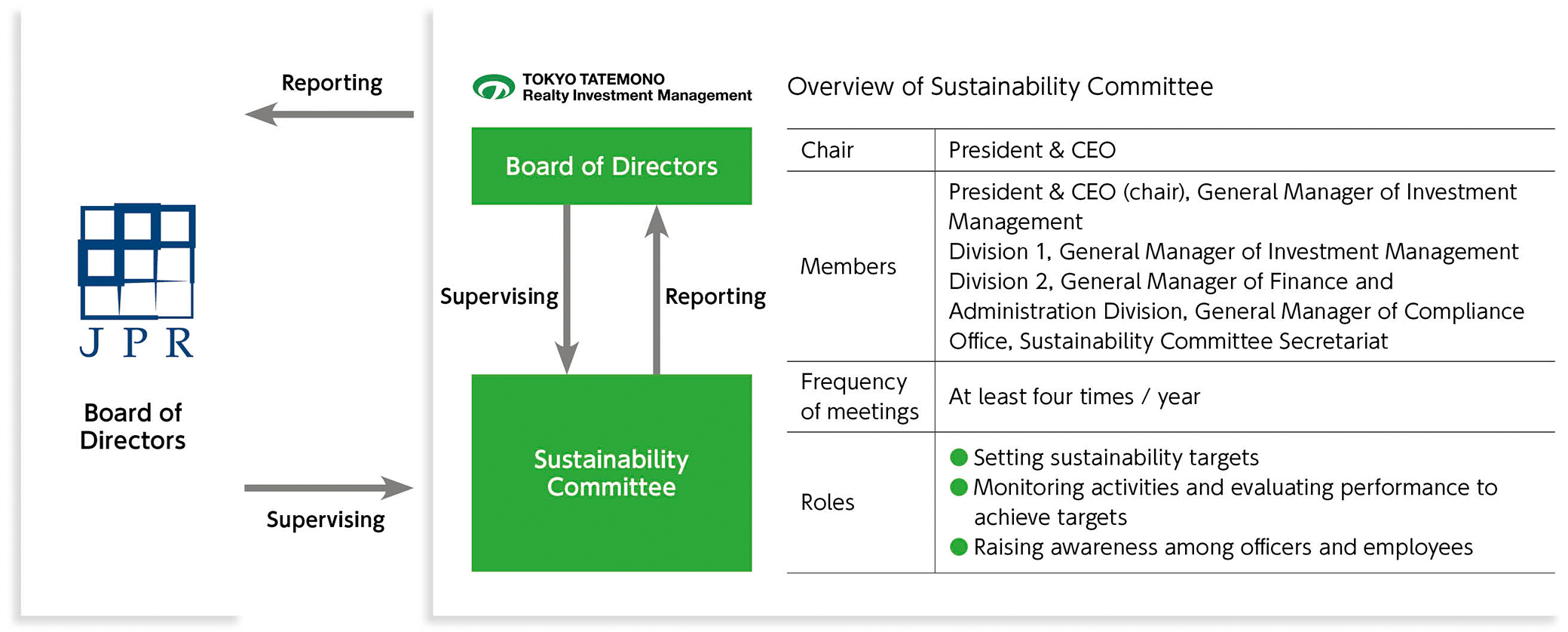 *The Sustainability Committee has invited outside experts with knowledge of sustainability as special committee members.
Strategies
Scope of analysis
JPR has conducted multiple scenario-based analyses to understand the risks and opportunities of climate change and to evaluate their impact on its business.
The scenario analysis conducted this time covered all properties owned by JPR.
External scenarios referenced
Transition Risk: Risks associated with the transition to a decarbonized society. Reference scenario (forecast analysis of carbon tax, electricity, and energy prices): IEA World Energy Outlook
Physical risks caused by climate change itself. Reference scenario (e.g., occurrence of water damage) : WWF Water Risk Filter
Future world view of each scenario
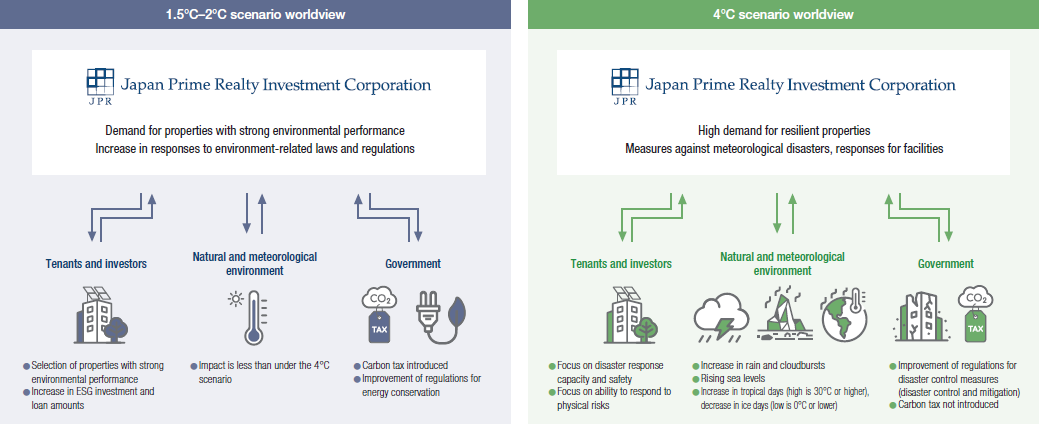
Identification of risks and opportunities
By utilizing the knowledge of external experts, JPR identified the following risks and opportunities based on the scenario analysis and quantitatively evaluated their financial impact.
In addition, JPR is working with relevant departments to consider and implement countermeasures for the identified risks and opportunities.
(Unit: million yen)
| Type of risks | Risks and opportunities |
Item | Financial Impact (operating income basis) |
Strategies | ||||
|---|---|---|---|---|---|---|---|---|
| 1.5℃/2℃ | ~4℃ | |||||||
| 2030 | 2050 | 2030 | 2050 | |||||
Transition Risks and Opportunities |
Policy and regulations | Risks | Increase of costs due to the imposition of carbon taxes | ▲239 | ▲649 | ▲239 | ▲410 | Purchase of non-fossil certificates, expansion of renewable energy procurement, implementation of energy-saving retrofit and reduction due to a decrease in the emission factor |
| Cost of taking measures to achieve emission reduction targets | ▲23 | ▲287 | ▲12 | ▲82 | ||||
| Increase in construction expenses due to the imposition of carbon taxes | ▲136 | ▲370 | ▲136 | ▲234 | Increase in investment efficiency and revision of retrofit plan | |||
| Increase in expenses for building management contracts due to the tightening of regulations associated with climate change | ▲4 | ▲6 | 0 | 0 | Cooperation with PM and BM (rationalization of operations) | |||
| Increase in expenses for obtaining environmental certifications | ▲8 | ▲12 | 0 | 0 | Increase in properties’ competitiveness due to environmental certifications | |||
| Opportunities | Decrease in carbon tax expenses due to the achievement of GHG emission reduction targets | +51 | +649 | +51 | +410 | Purchase of non-fossil certificates, expansion of renewable energy procurement, implementation of energy-saving retrofit and reduction due to a decrease in the emission factor | ||
| Market | Risks | Increase in amount invested in energy conservation | ▲18 | ▲13 | 0 | 0 | Cost reduction through the rationalization of the need for facilities and the decrease of energy consumption | |
| Increase in operation expenses due to an increase in energy prices | ▲100 | ▲91 | ▲41 | +53 | Reduction of energy consumption and water, heating and lighting expenses | |||
| Fall in the occupancy rate due to delays in implementing measures for green buildings | ▲380 | ▲578 | 0 | 0 | Increase in the percentage of properties that have obtained environmental certifications and improvement of environmental performance due to property replacement | |||
| Decrease in rents due to delays in implementing measures for green buildings | ▲18 | ▲129 | 0 | 0 | ||||
| Increase in financing costs due to delays in implementing measures for green buildings | ▲45 | ▲125 | 0 | 0 | Promotion of communication with investors and lenders and increase of ratings by ESG rating organizations | |||
| Opportunities | Reduction of energy expenses due to energy-saving retrofit | +34 | +40 | 0 | 0 | Increase in investment efficiency and revision of retrofit plan | ||
| Increase in occupancy rates due to measures taken for green buildings | +380 | +578 | 0 | 0 | Increase in the percentage of properties that have obtained environmental certifications and improvement of environmental performance due to property replacement | |||
| Increase in rents due to measures taken for green buildings | +18 | +129 | 0 | 0 | ||||
| Decrease in financing costs due to measures taken for green buildings | +45 | +125 | 0 | 0 | ||||
Physical Risks and Opportunities |
Acute | Risks | Increase in repair expenses due to unpredictable storms and flood damage | ▲9 | ▲14 | ▲9 | ▲14 | Expansion of anti-flood facilities and training for responding to flooding |
| Decrease in rents due to unpredictable storms and flood damage | ▲9 | ▲9 | ▲17 | ▲17 | Expansion of response due to non-life insurance | |||
| Opportunities | Flood damage covered using non-life insurance | +9 | +14 | +9 | +14 | Expansion of anti-flood facilities and training for responding to flooding | ||
| Avoid decrease in rents using non-life insurance | +9 | +9 | +17 | +17 | Expansion of response due to non-life insurance | |||
| Chronic | Risks | Increase of non-life insurance premiums | ▲23 | ▲35 | ▲24 | ▲37 | Rationalization of increased expenses and increasing resilience (improvement of insurance valuation) | |
| Increase in energy cost in summer attributed to chronic temperature increase | ▲0 | ▲4 | ▲2 | ▲12 | Decrease in energy consumption due to facility renovation, and cooperation with tenants (promotion of energy conservation measures) | |||
| Opportunities | Decrease in energy cost in winter attributed to chronic temperature increase | 0 | +2 | +1 | +5 | |||
Analysis Using CRREM
Outline of CRREM
CRREM (Carbon Risk Real Estate Monitor) provides a tool to visualize the risks of retrofitting individual properties and portfolios based on carbon reduction pathways for the 1.5°C and 2°C goals for the reduction of GHG emissions by 2050 in accordance with the Paris Agreement. By comparing data of its properties subject to analysis with the pathways, JPR expects to continue its consideration for determining the timing when individual properties and portfolio will become stranded assets as well as carbon cost, and understanding renovation work and the scale of renewable energy to be introduced, which are needed to accommodate the above.
-
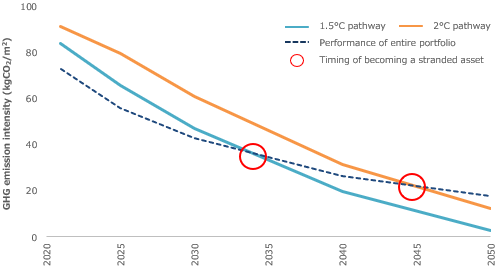
A) Scenario based on the existing energy saving renovation plan
- Scenario reflecting the energy saving renovations that are planned
-
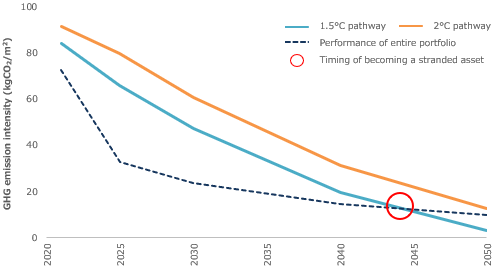
B) Scenario reflecting a renewable energy introduction plan
- Scenario reflecting greater investment in energy saving renovations and a plan for the introduction of renewable energy(Note 1)
Results of analysis using CRREM
JPR conducted an analysis of its properties held (as of December 2021) regarding their risk of becoming stranded assets, using CRREM risk assessment tool (v1.22 Asia-Pacific Region) and CRREM Global Pathways v1.093.(Note 2) Part of the parameters (grid electricity emission factor, carbon prices, etc.) in the tool were adjusted to take into account the circumstances in Japan.
The result of the analysis shows that in Scenario A, pathways to the 1.5°C and 2°C goals will be surpassed around 2033 and around 2044, respectively, and in Scenario B, the pathway to the 1.5°C goal will be surpassed around 2043. Based on the results of the analysis, JPR will consider retrofitting measures and renovations for properties that place significant burdens on the environment, replacing assets and taking other measures.
- In Scenario B, the effects of off-site renewable energy, which is not a requirement in CRREM, are reflected in the property performance.
- As CRREM emphasizes the overall performance of buildings, the consumption of different types of energy, etc. are input for entire buildings or the entire scope of unit ownership, irrespective of the percentage ownership.
Roadmap to the 2030 target and net zero by 2050
JPR has set a 46.2% reduction in total GHG emissions (compared to 2019) by 2030 based on scientific basis regarding GHG emission reductions, and has also set the target of net-zero emissions by 2050. We will formulate specific measures and implement related initiatives to reduce emissions toward achieving these targets.
GHG emission reduction plan
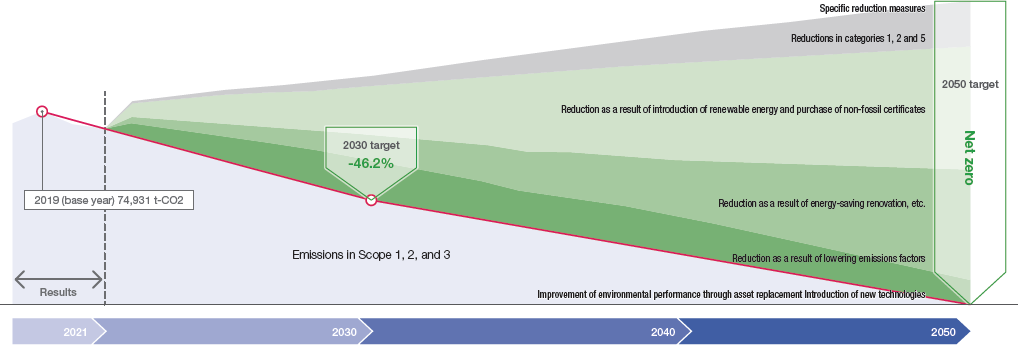
Specific initiatives to address risks and opportunities
Measures to achieve the plan
JPR is engaged in environmental and energy-saving measures, such as upgrading to highly energy-efficient facilities and improving operating methods, while measuring GHG emission figures to reduce GHG emissions.
Equipment improvement initiatives
Upgrading to highly energy-efficient air-conditioning equipment
Power consumed by air-conditioning equipment represents a significant percentage of the power consumed by the entire building, with power demand increasing sharply during the hot summer months in particular. Air-conditioning equipment is being systematically upgraded to improve economic efficiency and comfort and reduce GHG emissions.
Upgrading to LED lighting
Lighting of exclusive-use areas and common areas are being replaced with LED lighting to reduce power consumption.
Upgrading to lighting fixtures with motion detectors
Motion detectors respond to the movement of people and changes in brightness to provide illumination only when needed, which reduces power consumption preventing people from forgetting to turn off the lights. JPR is working to reduce power consumption by installing motion detectors in restrooms, staff kitchens, and stairways when carrying out common-area renovations so that lights will be turned off when these areas are not in use.
Switch of energy suppliers
Review of power comapanies
JPR monitors current CO2 emission factors on a regular basis and is working to reduce GHG emissions by reviewing power supply contracts. We not only make judgments based on CO2 emission factors but also check the evidence, the mix of energy sources and ways to offset our carbon footprint.
Introducing renewable energy sources
Renewable energy is defined as energy that is produced by natural resources and does not produce greenhouse gases. Examples include solar energy, wind energy, geothermal energy, small and medium hydropower, and biomass. JPR is a REIT that invests in urban office properties. We have limited space for installing solar panels and primarily procure renewable energy from outside. JPR is increasing its use of renewable energy, considering its characteristics and procurement costs. The government’s 7th Strategic Energy Plan states that solar power is expected to become a major power source by 2040. Given the current power source configuration, solar power generation is a promising option. We have examined how much solar power we will be able to procure, considering the characteristics of JPR’s portfolio.
- Surplus energy tends to be generated on Saturdays, Sundays and public holidays
- Surplus energy tends to be generated from March through May due to a decrease in the use of air-conditioners
- The effect of installation is high for large buildings
- The difference between consumption on weekdays and weekends is not significant
- In some cases, surplus energy is generated at the beginning of solar power generation (in the morning)
If we use the electricity generated from solar power, we now expect to meet 15% to 20% of the needs of JPR’s properties from solar power.
The primary methods through which JPR can procure renewable energy are as follows.
| Method | Category | Outline |
|---|---|---|
| Purchase FIT Non-Fossil Certificates | Equivalent to renewable energy | The market distribution volume is larger than any other method. This has a risk of procurement price fluctuation. |
| Purchase of non-FIT non-Fossil certificates | Equivalent to renewable energy | Procured under bilateral contracts. Rules after 2030 are not in place. |
| Virtual CPPA | Equivalent to renewable energy | A bilateral contract with a power generation company. Long-term stable procurement is possible. |
| Physical CPPA | Renewable energy | We can suppress price fluctuations and secure energy-saving electricity for a long period of time. |
| We cannot rely on a few specific power sources to achieve 100% renewable energy (we need to use storage batteries). | ||
| Self-consignment | Renewable energy | We can procure electricity via the electricity transmission and distribution network from facilities we own in remote locations. |
| The system has changed, and now we must consume all the electricity only for our own use. (The rules have been tightened.) | ||
| Specific power supply value (hydroelectricity source) |
Renewable energy | Electricity is procured from hydroelectric sources. Procurement quantities may vary due to dry seasons |
Operational improvement initiatives
| Category | Measure | Key Initiatives |
|---|---|---|
| Lighting | Turning off the lights when rooms are vacant | Creating standards for turning lighting on and off and promoting turning lights off when rooms are vacant |
| Floor management of common-area lighting | Managing lighting of common areas according to use by tenants | |
| Air-conditioning equipment | Changing air-conditioning temperature to recommended values | Recommending that tenants adopt appropriate temperature settings for air-conditioning |
| Turning off air-conditioning power in empty rooms | Turning off air-conditioning equipment power in empty rooms to stop consumption of standby power | |
| Prohibiting entry of outside air during pre-warming/ pre-cooling | Restricting the entry of outside air during pre-warming/pre-cooling in order to reduce air-conditioning loads | |
| Other equipment | Changing contract demand | Reviewing method of operating control equipment for the purpose of reducing contract demand and turning off equipment that is always on standby where appropriate |
| Improving power factor using condensers | Improving power factor through careful control of condensers and reducing electrical circuit and transformer energy loss | |
| Seasonal adjustment of heated toilet seat temperatures | Managing toilet seat heating and washing water temperatures by adjusting the settings according to the season | |
| Seasonal management of times when outdoor lights are turned on | Automatically turning off exterior lights and managing the times when they are lit according to the season |
Improving building resilience
TRIM conducts onsite inspections of all portfolio properties (except land with leasehold interest) at least once a year, in principle, to assess whether they are equipped to withstand disaster (including typhoon, heavy rain, flood, and earthquake), checking for any new risks and seeking to mitigate the risk of damage, loss or degradation of the properties. We are also implementing resilience measures utilizing disaster forecasts, such as regularly checking for hazard map updates in the areas where our properties are located.
Risk management
Risk management
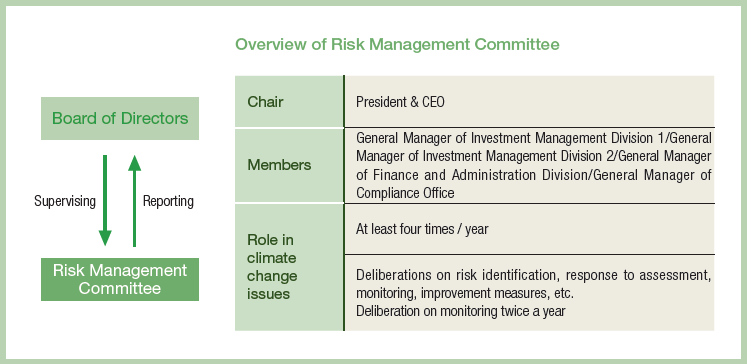
Climate change risks are integrated with risks related to operations and management. They are monitored and managed through multiple verification systems. TRIM has established the Risk Management Committee to improve the effectiveness of its risk management, in accordance with its Risk Management Regulations. This committee deliberates on topics including risk identification, response to assessment, monitoring, and improvement measures. Contents, progress, and results of the committee’s deliberations are reported to the Board of Directors.
The Sustainability Committee also uses a risk monitoring sheet prepared by the Sustainability Secretariat for confirmation.
Risk management process
TRIM monitors all risks—including climate change risks—twice a year, and the Risk Management Committee deliberates on these risks. Details of initiatives taken every year are summarized and plans for the next year formulated at the end of each year are reported to TRIM’s Board of Directors.
Metrics and targets
GHG emission reduction targets
JPR has formulated GHG emission reduction targets with a view to the 2050 net-zero target, and acquired SBTi approval for these targets as having a scientific basis and being consistent with the levels required by the Paris Agreement. JPR has also set a broader target of reducing total GHG emissions — including Scope 3 emissions — by 46.2% (compared to 2019) by 2030.
| Target | Base year | Target year | Scope of GHG | GHG emission reduction targets |
|---|---|---|---|---|
| Interim target | 2019 | 2030 | Scope 1 + 2 + 3 | 46.2% reduction |
| Long-term target | 2019 | 2050 | Scope 1 + 2 + 3 | Net zero |
Changes in GHG emissions
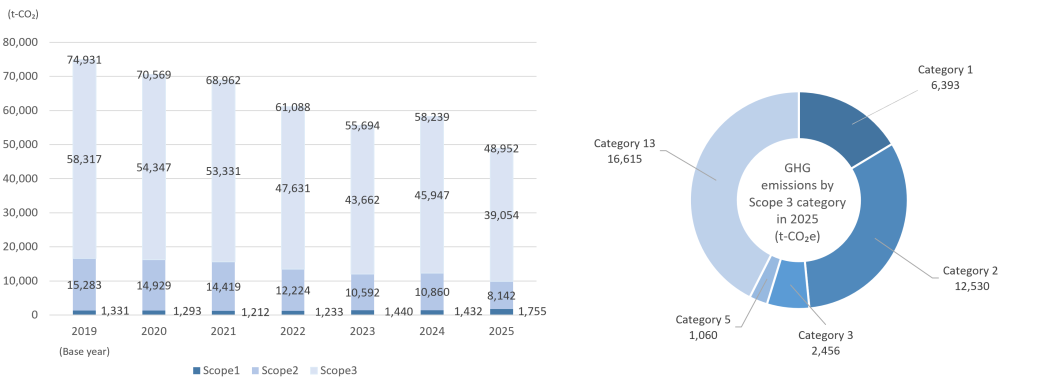
Environmental data (Collection period: January through December)
Some environmental data contained in this report have been assured by LRQA to ensure the reliability of the data reported. The types and values of applicable data are marked with an asterisk (*).
| Category/Unit | FY 2019 | FY 2022 | FY 2023 | FY 2024 | FY 2025 | |
|---|---|---|---|---|---|---|
| Electricity Use* | Total (MWh) | 92,952 | 96,087 | 94,107 | 94,492 | 95,618 |
| Intensity (MWh/㎡) | 0.143 | 0.144 | 0.138 | 0.135 | 0.119 | |
| Gas and other fuel consumption* | Total (MWh) | 17,170 | 17,142 | 16,751 | 17,207 | 18,750 |
| Intensity(MWh/㎡) | 0.026 | 0.026 | 0.025 | 0.025 | 0.023 | |
| Heat Consumption* | Total (MWh) | 12,681 | 14,925 | 16,111 | 16,290 | 11,744 |
| Intensity (MWh/㎡) | 0.019 | 0.022 | 0.024 | 0.023 | 0.015 | |
| Energy consumption* | Total (MWh) | 122,803 | 128,154 | 126,969 | 127,989 | 126,112 |
| Intensity (MWh/㎡) | 0.188 | 0.192 | 0.186 | 0.183 | 0.157 | |
| Water Use* | Total(㎡) | 524,170 | 480,162 | 504,819 | 498,363 | 545,123 |
| Intensity (㎡/㎡) | 0.804 | 0.720 | 0.740 | 0.713 | 0.680 | |
| Scope1* | Total (t-CO2) | 1,331 | 1,233 | 1,440 | 1,432 | 1,755 |
| Intensity (t-CO2/㎡) | 0.0020 | 0.0018 | 0.0021 | 0.0020 | 0.0022 | |
| Scope2* (Market basis) |
Total (t-CO2) | 15,283 | 12,224 | 10,592 | 10,860 | 8,142 |
| Intensity (t-CO2/㎡) | 0.0235 | 0.0180 | 0.0155 | 0.0155 | 0.0101 | |
| Scope2* (Location basis) |
Total (t-CO2) | 14,345 | 13,626 | 13,750 | 14,103 | 14,964 |
| Intensity (t-CO2/㎡) | 0.0220 | 0.0201 | 0.0201 | 0.0202 | 0.0175 | |
| Scope1+2* (Market basis) |
Total (t-CO2) | 16,614 | 13,457 | 12,032 | 12,292 | 9,897 |
| Intensity (t-CO2/㎡) | 0.0255 | 0.0199 | 0.0176 | 0.0176 | 0.0123 | |
| Scope1+2* (Location basis) |
Total (t-CO2) | 15,676 | 14,859 | 15,190 | 15,535 | 16,719 |
| Intensity (t-CO2/㎡) | 0.0241 | 0.0219 | 0.0223 | 0.0222 | 0.0197 | |
| Scope3* | 58,317 | 47,631 | 43,662 | 45,947 | 39,054 | |
| Category 1* | (t-CO2e) | 5,906 | 5,946 | 6,146 | 6,475 | 6,393 |
| Category 2* | (t-CO2e) | 9,942 | 9,861 | 11,901 | 14,442 | 12,530 |
| Category 3* | (t-CO2e) | 3,098 | 3,267 | 2,872 | 2,890 | 2,456 |
| Category 4* | (t-CO2e) | N/A | N/A | N/A | N/A | N/A |
| Category 5*(Note 1) | (t-CO2e) | 2,894 | 1,968 | 2,360 | 2,236 | 1,060 |
| Category 6* | (t-CO2e) | N/A | N/A | N/A | N/A | N/A |
| Category 7* | (t-CO2e) | N/A | N/A | N/A | N/A | N/A |
| Category 8* | (t-CO2e) | N/A | N/A | N/A | N/A | N/A |
| Category 9* | (t-CO2e) | N/A | N/A | N/A | N/A | N/A |
| Category 10* | (t-CO2e) | N/A | N/A | N/A | N/A | N/A |
| Category 11* | (t-CO2e) | N/A | N/A | N/A | N/A | N/A |
| Category 12* | (t-CO2e) | N/A | N/A | N/A | N/A | N/A |
| Category 13* | (t-CO2e) | 36,477 | 26,589 | 20,383 | 19,904 | 16,615 |
| Category 14* | (t-CO2e) | N/A | N/A | N/A | N/A | N/A |
| Category 15* | (t-CO2e) | N/A | N/A | N/A | N/A | N/A |
- The data shown in the table is based on the data that is available to JPR.
- Energy consumption, water use and GHG emissions data is also broken down into office property and retail property categories for further verification. The intensity is presented based on the calculation of (Total amount of electric power or CO₂)/(Total floor area of equities (m2) x (Average occupancy rate per year (%))
- The extent of data collection has expanded since 2024 and has included in gas, fuel oil A, diesel oil, and kerosene.
- Until 2023, the collection period of category 5 was April through March. Starting in 2024, the period was from January to December.